Vented vs Unvented Crawl Space: What R408 Requires
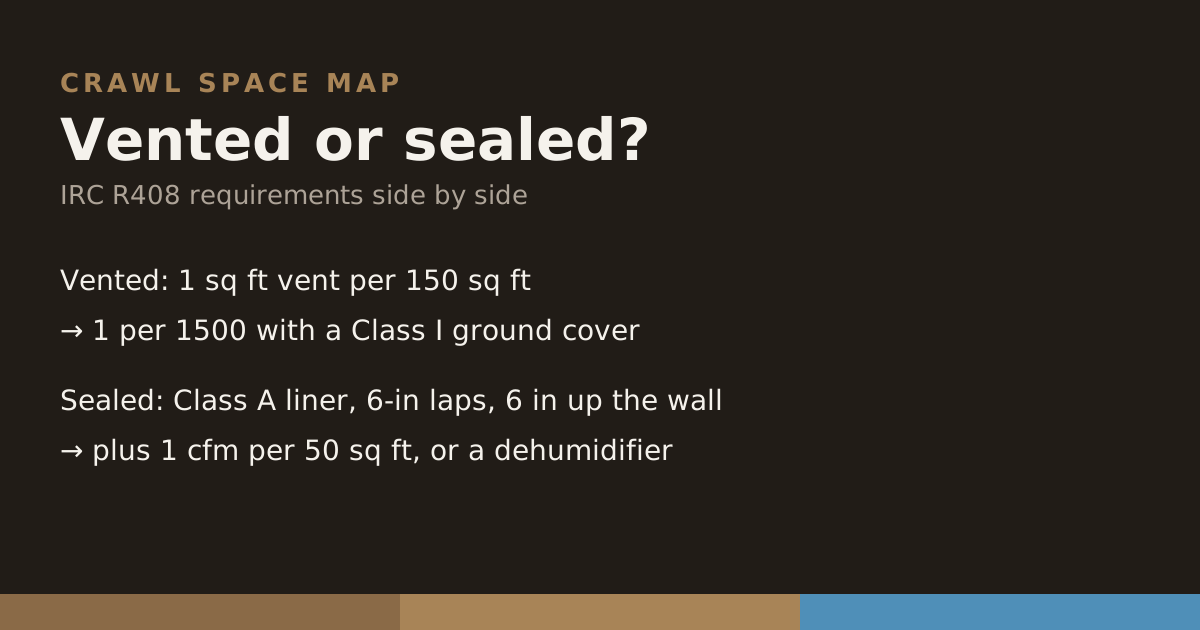
The International Residential Code allows two kinds of crawl space, and Section R408 sets out what each needs.
Vented (R408.1–R408.2)
A vented crawl space needs net ventilation openings of at least 1 square foot for every 150 square feet of under-floor area, with one opening within 3 feet of each corner for cross-ventilation. If the ground is covered with an approved Class I vapor retarder, the vent area may drop to 1 in 1500 — a tenth of the bare-earth figure. That reduction is the code's own admission of where most of the moisture comes from: the ground, not the air.
A 1,500 sq ft crawl space therefore needs 10 sq ft of vent over bare earth, or 1 sq ft with a ground cover.
Unvented (R408.3)
A sealed crawl space drops the vents entirely and requires:
- A continuous vapor retarder (Class A, ASTM E1745 in South Carolina's adopted text) over all exposed earth, seams overlapped 6 inches and sealed or taped, edges carried at least 6 inches up the stem wall and sealed to it.
- One of: continuous mechanical exhaust at 1 cfm per 50 sq ft of floor with an air path to the house; conditioned supply air at the same rate with a return path; use as a plenum (existing buildings); or a dehumidifier sized to the manufacturer's specification.
- Insulated perimeter walls in the exhaust and supply options.

Which suits which soil
Venting works when the outside air is drier than the crawl space. In humid summers in the Southeast it is not, and vented crawl spaces there condense moisture on cool ducts and joists. Add soil that stays wet — the high and elevated counties on this map — and the ground keeps feeding water from below. That combination is why sealed crawl spaces dominate new construction in wet, humid regions.
Where the water table is shallow, neither option is enough on its own: water standing on the crawl-space floor needs a perimeter drain or sump before any liner goes down. The calculator sizes vents, airflow and liner for any footprint.
States amend R408 — Washington, for instance, requires 1 per 300 and a 6-mil ground cover — so check your local adopted code.